
Introduction and Overview
We have written this privacy policy (version 10.11.2025-113077612) to explain to you, in accordance with the requirements of the General Data Protection Regulation (EU) 2016/679 and applicable national laws, which personal data (data for short) we as the controller – and the processors commissioned by us (e.g. providers) – process, will process in the future and what lawful options you have. The terms used are to be understood as gender-neutral.
In short: We provide you with comprehensive information about the data we process about you.
Privacy policies usually sound very technical and use legal terminology. This privacy policy, however, is intended to describe the most important things to you as simply and transparently as possible. Where it serves transparency, technical terms are explained in a reader-friendly way and links to further information are provided. We hereby inform you in clear and simple language that we only process personal data in the course of our business activities when there is a corresponding legal basis.
If you still have questions, please contact the responsible party named below or in the legal notice. You can of course also find our contact details in the legal notice.
Scope
This privacy policy applies to all personal data processed by us in the company and to all personal data that companies commissioned by us (processors) process. By personal data we mean information within the meaning of Art. 4 No. 1 GDPR, such as a person's name, email address and postal address. The processing of personal data ensures that we can offer and bill our services and products, whether online or offline. The scope of this privacy policy includes:
- all online presences (websites, online shops) that we operate
- social media presences and email communication
- mobile apps for smartphones and other devices
In short: This privacy policy applies to all areas in which personal data is processed in a structured manner in the company via the channels mentioned. Should we enter into legal relationships with you outside of these channels, we will inform you separately if necessary.
Legal Bases
In the following privacy policy, we provide you with transparent information about the legal principles and regulations, i.e. the legal bases of the General Data Protection Regulation, that enable us to process personal data.
As far as EU law is concerned, we refer to REGULATION (EU) 2016/679 OF THE EUROPEAN PARLIAMENT AND OF THE COUNCIL of 27 April 2016. You can of course read this EU General Data Protection Regulation online on EUR-Lex, the gateway to EU law, at https://eur-lex.europa.eu/legal-content/EN/ALL/?uri=celex%3A32016R0679.
We only process your data if at least one of the following conditions applies:
- Consent (Article 6(1)(a) GDPR): You have given us your consent to process data for a specific purpose. An example would be the storage of data you entered into a contact form.
- Contract (Article 6(1)(b) GDPR): To fulfil a contract or pre-contractual obligations with you, we process your data. For example, if we conclude a purchase contract with you, we need personal information in advance.
- Legal obligation (Article 6(1)(c) GDPR): If we are subject to a legal obligation, we process your data. For example, we are legally obliged to keep invoices for accounting purposes. These usually contain personal data.
- Legitimate interests (Article 6(1)(f) GDPR): In the case of legitimate interests that do not restrict your fundamental rights, we reserve the right to process personal data. For example, we need to process certain data to operate our website securely and economically efficiently. This processing is therefore a legitimate interest.
Other conditions such as the performance of tasks in the public interest and the exercise of official authority as well as the protection of vital interests generally do not apply in our case. If such a legal basis should be relevant, it will be indicated in the appropriate place.
In addition to the EU regulation, national laws also apply:
- In Austria, this is the Federal Act on the Protection of Natural Persons with regard to the Processing of Personal Data (Data Protection Act), or DSG for short.
- In Germany, the Federal Data Protection Act, or BDSG for short, applies.
If further regional or national laws apply, we will inform you about them in the following sections.
Contact Details of the Controller
If you have questions about data protection or the processing of personal data, you will find below the contact details of the controller pursuant to Article 4(7) of the EU General Data Protection Regulation (GDPR):
SKYVOLUTION Energy GmbH
Registered office: 3433 Königstetten
Peter Rosegger Str. 13 | Austria
Email: roland.altenberger@skyvolution.at
Phone: +43 664 4202035
Legal notice: https://www.skyvolution.at/impressum//
Storage Duration
That we only store personal data for as long as is absolutely necessary for the provision of our services and products is a general criterion for us. This means that we delete personal data as soon as the reason for the data processing no longer exists. In some cases, we are legally obliged to store certain data even after the original purpose has ceased, for example for accounting purposes.
If you wish to have your data deleted or revoke your consent to data processing, the data will be deleted as quickly as possible, provided there is no obligation to store it.
We will inform you below about the specific duration of the respective data processing, if we have further information on this.
Rights under the General Data Protection Regulation
In accordance with Articles 13 and 14 of the GDPR, we inform you of the following rights to which you are entitled to ensure fair and transparent processing of data:
- Under Article 15 GDPR, you have a right of access as to whether we process data about you. If this is the case, you have the right to receive a copy of the data and to learn the following information:
- for what purpose we carry out the processing;
- the categories, i.e. the types of data being processed;
- who receives this data and, if the data is transferred to third countries, how security can be guaranteed;
- how long the data is stored;
- the existence of the right to rectification, erasure or restriction of processing and the right to object to processing;
- that you can lodge a complaint with a supervisory authority (links to these authorities can be found below);
- the origin of the data, if we did not collect it from you;
- whether profiling is carried out, i.e. whether data is automatically evaluated to create a personal profile of you.
- Under Article 16 GDPR, you have a right to rectification of data, which means that we must correct data if you find errors.
- Under Article 17 GDPR, you have the right to erasure ("right to be forgotten"), which specifically means that you may request the deletion of your data.
- Under Article 18 GDPR, you have the right to restriction of processing, which means that we may only store the data but not use it further.
- Under Article 20 GDPR, you have the right to data portability, which means that we will provide you with your data in a commonly used format upon request.
- Under Article 21 GDPR, you have a right to object, which, once enforced, results in a change in processing.
- If the processing of your data is based on Article 6(1)(e) (public interest, exercise of official authority) or Article 6(1)(f) (legitimate interest), you can object to the processing. We will then check as quickly as possible whether we can legally comply with this objection.
- If data is used for direct marketing purposes, you can object to this type of data processing at any time. We may then no longer use your data for direct marketing.
- If data is used for profiling purposes, you can object to this type of data processing at any time. We may then no longer use your data for profiling.
- Under Article 22 GDPR, you may have the right not to be subject to a decision based solely on automated processing (e.g. profiling).
- Under Article 77 GDPR, you have the right to lodge a complaint. This means you can complain to the data protection authority at any time if you believe that the processing of personal data violates the GDPR.
In short: You have rights – do not hesitate to contact the responsible party listed above!
If you believe that the processing of your data violates data protection law or your data protection rights have been violated in any other way, you can complain to the supervisory authority. For Austria, this is the Data Protection Authority, whose website you can find at https://www.dsb.gv.at/. In Germany, there is a data protection officer for each federal state. For further information, you can contact the Federal Commissioner for Data Protection and Freedom of Information (BfDI). The following local data protection authority is responsible for our company:
Contact Form
|
Contact Form Summary
👥 Affected parties: Persons who contact us via the contact form 🤝 Purpose: Responding to your contact enquiry 📓 Data processed: Name, email address, subject and message content 📅 Storage duration: Until your enquiry has been fully answered, unless statutory retention obligations apply ⚖️ Legal bases: Art. 6(1)(b) GDPR (Contract or pre-contractual measures), Art. 6(1)(f) GDPR (Legitimate interests), Art. 6(1)(a) GDPR (Consent) |
What is the contact form and what data is processed?
A contact form is available on our website through which you can send us enquiries. The following data is collected as mandatory fields: your name, your email address and the subject of your enquiry. You may also voluntarily provide further information in the message field.
Why do we process this data?
The processing of this data serves exclusively to answer your enquiry quickly and straightforwardly. Without this information, we cannot assign your message or respond to you.
How long is the data stored?
The data collected via the contact form is only stored until your enquiry has been fully answered, unless statutory retention obligations apply. If your enquiry constitutes pre-contractual communication (e.g. a request for a quote), the statutory retention periods apply.
Legal basis
If your enquiry is aimed at concluding a contract, the legal basis for the processing is Art. 6(1)(b) GDPR (performance of pre-contractual measures). For general enquiries, we rely on our legitimate interest in responding to your message pursuant to Art. 6(1)(f) GDPR. If you grant your consent to data processing via the checkbox in the contact form, Art. 6(1)(a) GDPR also serves as a legal basis. You have the right to withdraw your consent at any time. The lawfulness of the processing carried out on the basis of the consent until the withdrawal remains unaffected.
The data will not be shared with third parties.
Web Hosting Introduction
|
Web Hosting Summary
👥 Affected parties: Visitors to the website 🤝 Purpose: Professional hosting of the website and security of operations 📓 Data processed: IP address, time of website visit, browser used and other data. More details can be found below or from the respective web hosting provider. 📅 Storage duration: Depends on the respective provider, but usually 2 weeks ⚖️ Legal bases: Art. 6(1)(f) GDPR (Legitimate interests) |
What is web hosting?
When you visit websites nowadays, certain information – including personal data – is automatically created and stored, including on this website. This data should be processed as sparingly as possible and only with justification. By website, we mean the entirety of all web pages on a domain, i.e. everything from the start page (homepage) to the very last subpage (like this one). By domain, we mean, for example, example.com or sampleexample.com.
To view a website on a computer, tablet or smartphone, you use a program called a web browser. You probably know a few web browsers by name: Google Chrome, Microsoft Edge, Mozilla Firefox and Apple Safari. We call them browsers or web browsers for short.
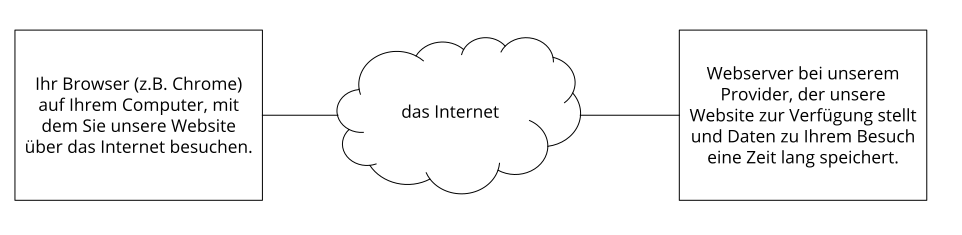
To display the website, the browser must connect to another computer where the code of the website is stored: the web server. Operating a web server is a complicated and costly task, which is why it is usually done by professional providers. These offer web hosting and thus ensure reliable and error-free storage of website data. Quite a lot of technical terms, but please stay with us, it gets even better!
When the browser on your computer (desktop, laptop, tablet or smartphone) connects and during the data transfer to and from the web server, personal data may be processed. On the one hand, your computer stores data, and on the other hand, the web server must also store data for a period of time to ensure proper operation.
A picture says more than a thousand words, so the following graphic illustrates the interplay between the browser, the internet and the hosting provider.
Why do we process personal data?
The purposes of data processing are:
- Professional hosting of the website and security of operations
- To maintain operational and IT security
- Anonymous evaluation of access behaviour to improve our offering and, if necessary, for prosecution or the pursuit of claims
What data is processed?
Even while you are visiting our website right now, our web server, i.e. the computer on which this website is stored, usually automatically stores data such as
- the complete internet address (URL) of the accessed web page
- browser and browser version (e.g. Chrome 87)
- the operating system used (e.g. Windows 10)
- the address (URL) of the previously visited page (referrer URL) (e.g. https://www.beispielquellsite.de/vondabinichgekommen/)
- the hostname and IP address of the device from which access is made (e.g. COMPUTERNAME and 194.23.43.121)
- date and time
- in files called web server log files
How long is data stored?
As a rule, the above-mentioned data is stored for two weeks and then automatically deleted. We do not pass on this data, but cannot rule out that this data may be viewed by authorities in the event of unlawful behaviour.
In short: Your visit is logged by our provider (the company that runs our website on special computers (servers)), but we do not pass on your data without consent!
Legal basis
The lawfulness of the processing of personal data in the context of web hosting arises from Art. 6(1)(f) GDPR (safeguarding of legitimate interests), as the use of professional hosting with a provider is necessary to present the company on the internet in a secure and user-friendly manner and to be able to pursue attacks and claims arising from this if necessary.
As a rule, there is a data processing agreement between us and the hosting provider in accordance with Art. 28 f. GDPR, which ensures compliance with data protection and guarantees data security.
World4You Privacy Policy
|
World4You Privacy Policy Summary
👥 Affected parties: Visitors to the website 🤝 Purpose: Website storage and accessibility on the internet 📓 Data processed: IP address, but primarily also technical data 📅 Storage duration: Log files are deleted after 14 days ⚖️ Legal bases: Art. 6(1)(f) GDPR (Legitimate interests) |
What is World4You?
It is quite possible that you have already heard of the web hosting provider World4You. The web host is particularly popular in Austria. The service provider is the Austrian company World4You Internet Services GmbH, Hafenstraße 35, 4020 Linz, Austria.
The company from the Upper Austrian capital has been active in the field of web hosting since 1998. World4You operates several of its own data centres in Austria and relies on in-house technology. This ensures fail-safe operation and a fast server connection. As you may have already read in our introduction to web hosting, data from you is also transferred to World4You's servers and processed there. This primarily concerns technical data such as browser version or operating system, but personal data is also processed with your IP address.
Why do we use World4You?
For a website, we value, probably much like you, reliability, speed and security. Even if you access our website in the middle of the night or we already have many visitors, it must function flawlessly. When you click on subpages, it must not take forever for the page to fully load. And if problems do arise, there should be a good backup system that secures our content and protects all data. To ensure all this works to our satisfaction, we naturally need a reliable web host. With World4You, we believe we have found a partner that meets our requirements. World4You has its own data centres and thus a fixed bandwidth, which makes a website quickly accessible. We also appreciate the company's personal support.
What data is processed by World4You?
World4You may also process personal data from you. Our web server automatically stores data while you visit our website. This includes personal data such as your IP address, but primarily also technical data such as the internet address of the website visited, device information such as browser version, operating system and the URL of the previously visited website. It is also recorded when you accessed our website and, where applicable, location data. The IP address can be used to enhance the security of the website, to detect possible errors and also to carry out anonymous statistical analyses. Cookies may also be used for data storage.
How long and where is the data stored?
The data is stored on World4You's own servers. The exact retention period of the data depends very much on the type of data and the individual configurations. In principle, World4You stores the data for as long as is necessary to fulfil its obligations. Data that is only collected to provide the website is deleted at the end of the respective session. For data stored in so-called log files, deletion takes place no later than 14 days afterwards. However, it may also happen that data is stored for longer, for example to have evidence for possible legal disputes.
How can I delete my data or prevent data storage?
You have the right at any time to access, rectify or delete and restrict the processing of your personal data. You can also revoke your consent to the processing of data at any time.
If you do not want these cookies to be set and data to be stored, you can also prevent the setting of cookies in your browser. In your browser, you can manage, deactivate or delete cookies. Depending on your browser, this works slightly differently.
In the "Cookies" section, you will find the corresponding links to the instructions for the most popular browsers.
Legal basis
On our part, there is a legitimate interest in using World4You in order to be able to offer our online service. The corresponding legal basis is Art. 6(1)(f) GDPR (Legitimate interests).
You can of course also use this support if you have specific questions about data protection at World4You. Also recommended is the privacy policy of the website, which you can find at https://www.world4you.com/de/unternehmen/datenschutzerklaerung.html. The FAQs at https://www.world4you.com/faq/de/dsgvo.html also have a dedicated GDPR section where you can find plenty of useful information.
Closing Remarks
Congratulations! If you are reading these lines, you have truly "battled" your way through our entire privacy policy or at least scrolled this far. As you can see from the scope of our privacy policy, we take the protection of your personal data anything but lightly.
It is important to us to inform you to the best of our knowledge and belief about the processing of personal data. We not only want to tell you which data is processed, but also explain the reasons for using various software programs. Privacy policies usually sound very technical and legal. Since most of you are not web developers or lawyers, we also wanted to take a different linguistic approach and explain the matter in simple and clear language. This is of course not always possible due to the subject matter.
If you have any questions about data protection on our website, please do not hesitate to contact us or the responsible party. We wish you a pleasant time and hope to welcome you back to our website soon.
All texts are protected by copyright.
Source: Privacy Policy created with the Privacy Policy Generator for Austria by AdSimple